World Building
It's 2050 and NYC Department of Parks & Housing department is preparing to accept applicants for the Great Lawn Park Village's 5th anniversary. The participants are greeted by Parks & Housing staff for the orientation session.
After watching the orientation video, staff introduces the participants to Folklore. Folklore was created by the Parks & Housing department in 2037, two years after the introduction of a series of amendments to Title 56 Section 1-04, following the introduction of the first Park Villages.
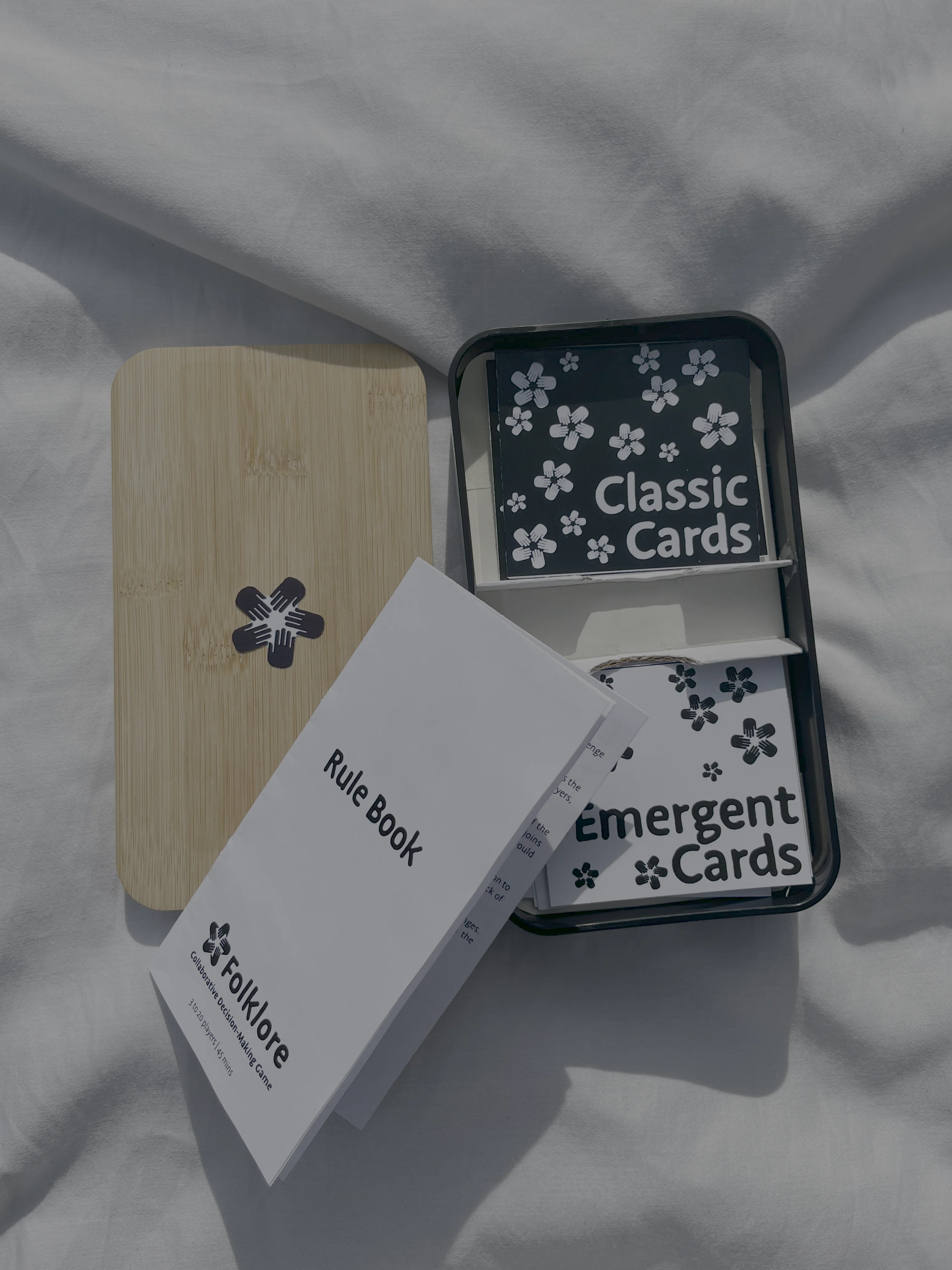
Classic Folklore simulates events and circumstances that impose limited resources over the participants, such as water supply. Each card has a hypothetical scenario which requires collective work to overcome. The participants discuss and at the end of the discussion collectively write down a statement on the card indicating how they would handle the situation. The card goes into the completed card pile for the respective Park Village. Each Park Village has access to the copies of the cards filled out by the residents of other Park Villages.
Emergent Folklore, the participants themselves come up with the hypothetical scenarios to play through with their neighbors.
Game Mechanics
The primary game mechanic we focused on was the discussion of a hypothetical situation. We understood that when a problem such as land use comes up in life, our discussions are highly impacted by our identities, social norms, and narratives about the location/situation at hand. We wanted to estrange the situation slightly, just enough that it allows people to step out of the roles that are indeed helpful in daily life, but are perhaps limiting to form connections with people who assume different roles and identities.
The two gameplay modes were very fun to think through and play through. We invited colleagues, friends and acquaintances to Union Square to play this game with us and test the game mechanics. We introduced the game and played through one Classic Folklore challenge where water was in short supply and we had to decide on how to use it. After two hours of discussion the group unanimously decided on the following statement: "We will prioritize each other."
In our gameplay we found that peple assumed roles similar to how they would in the oral game Vampire/Mafia. This performative nature of the discussion helped it feel like a game rather than a serious conversation. We found that this suits the nature of the game very well as our intention was to stimulate serious decisions they would need to make when communities face challenges of scarcity. If and when they face such challenges, they can go back to their discussions and use them as scaffolds rather than being led by fears of not having enough and infighting.
What I find most exciting is the idea that we are creating an archive of collective wisdom others in the same situation can reference later on at a different location or time.
Design Process
We talked to and invited people who are working around just land use and housing including: real estate agents, business development district CEOs, artists, Real Estate Investment Cooperative (REIC) board members, volunteers from Elizabeth Street Garden, HDP officials, affordable housing developers. We were pleased to have long virtual discussions with several of the people we invited, who gave us a better understanding of the housing crisis in NYC. At the same time, we were frustrated by our inability to gather everyone in the same room for a workshop. We ended up having 6 participants who were researchers, artists and business profesionals.
Futuring Workshop
I took inspiration from Emergent Strategies by adrienne maree brown for the workshop planning. We had two quick sessions where we broke up our participants in 3 groups and walked them through how to use the futuring wheel our group repurposed.
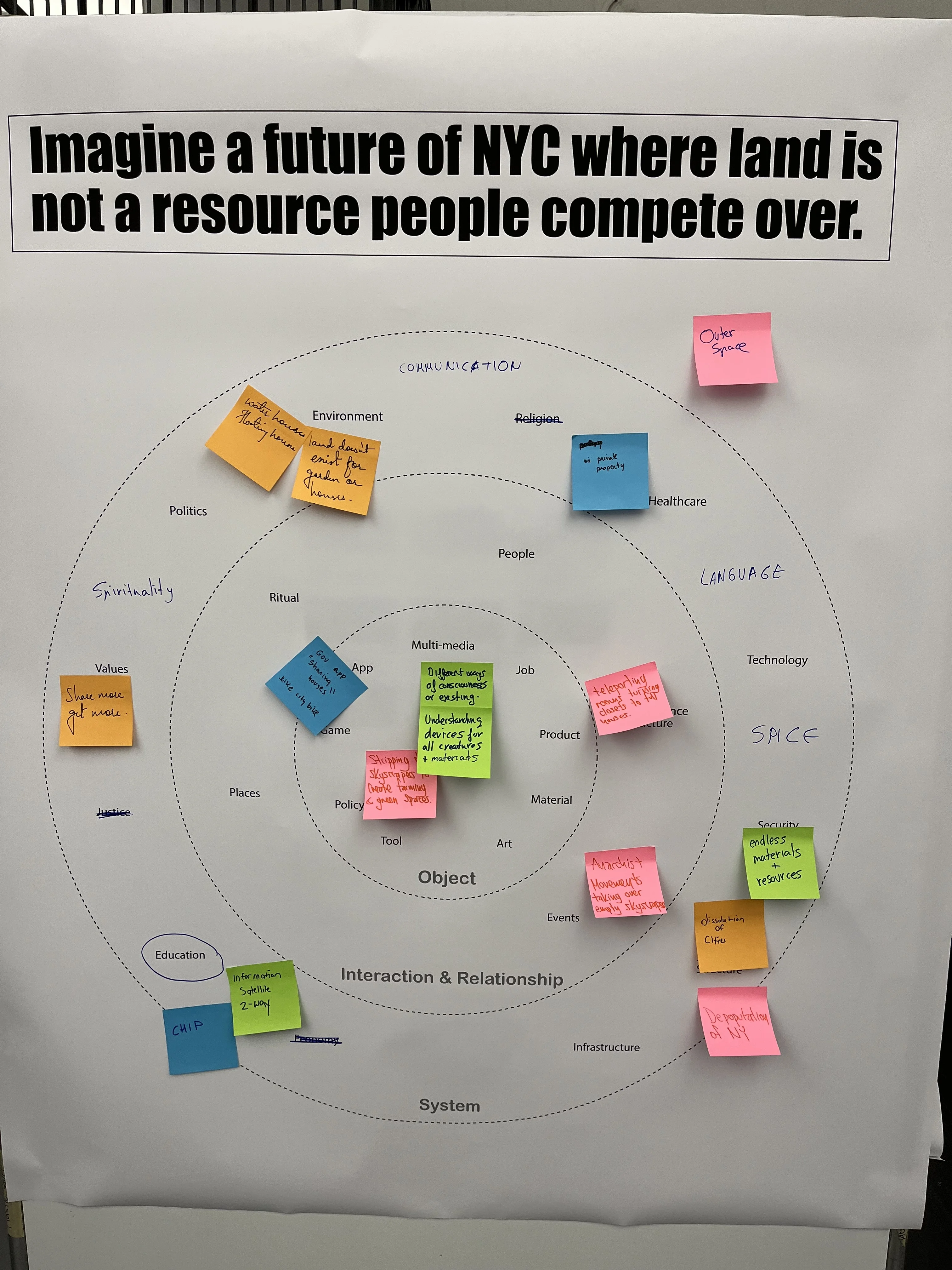
The main question we were asking them was "Imagine a future NYC where land is not a resource people compete over. What things would exist in this future to sustain it, keep it in place?" The three levels of the circle represent the different levels of things that could exist. For example, you could have a special language, or a piece of furniture, a specific department, or a type of job. While the main question exists to provide framing for the workshop, the examples and the circle exist to help generate ideas through association. We encouraged the participants to be as wild as they could be and not be limited to the existing categories. After the first session, we switched one person from each group so different ideas and divergences in thinking could cross-pollenate.
Synthesysing and Prototyping
After the workshop we came together as a group to go through all of ideas our participants had come up with during the workshop. We first came up with the qualities the future might have in terms of spectrums.
These are some of the examples we had.
Competitive <---> Collaborative
Saturated <---> Unsaturated
Low Tech <---> High Tech
Land Commoditized <---> Land Not Commoditized
--
We then chose 2 of these spectrums and used a 2x2 matrix to map all of the ideas to understand where each idea falls on the spectrum so we may choose the ideas that best fit our design values. After dot voting on the ideas we chose to prototype:
No Static Houses
After several hours making mood boards and discussing how the materials, the look and feel, the modularity of these living spaces could be we came to an understanding that we were more interested in investigating the experiences surrounding this future. We wanted to create situations in which collaboration and mutual understanding could be experiences in an imaginary future where land was not commoditized.
We ran several test sessions with our colleagues in the classroom and refined our gameplay. We created sample cards, rulebooks and materials for testing with people outside of our program.